The t-shirt itself is based on a contemporary press ad from December 1963 and focuses on the Commer's large load capacity. The print has a slightly distressed, retro feel to it and the t-shirt is available in sand or white, with the latter available up to 5XL.
Lockdown Legends – a range of motoring t-shirts designed during lockdown and based around the original press ads and photos, remembering when we could actually drive our cars – whether the journey was essential or not…
-
 The Commer FC van was produced from 1960 to 1976 when it was developed into the very similar Commer SpaceVan which soldiered on right up until 1983 under the Dodge name. It was a very distinctive van with its rounded profile and inset partially-enclosed front wheels, the latter due to its Humber car-derived front suspension. Its forward-control set up meant that the engine was placed between the front seats; great to work on in the rain, but less so if it had to be taken out, which necessitated removal of the front windscreen to enable it to be craned out of the passenger door! These were a familiar sight on UK roads for many years in their Post Office and British Telecom livery and there were a number of camper van conversions such as the Commer Highwayman - a more interesting and distinctly British alternative to the ubiquitous VW camper. Engines capacity started out at 1500 but were later upped to 1600, then 1725cc but even then, with a 70mph top speed and 0-50 time of 25 seconds, it could hardly be considered as spritely.
 -
The 'coke bottle' Cortina Mk3 was introduced in October 1970 replacing the more boxy Mk2 and bringing with it a swoopy new design language inspired by the products of its US parents. Engines ranged from the 1300 'Kent' cross-flow up to the 2 litre 'Pinto' overhead cam unit and five trim levels were available from base up to the twin headlight GXL. This gave the car a plethora of body, trim and price point options that helped the Cortina (in Mk3 and Mk4 guise) become the best-selling car of the 70s. The car on the t-shirt is possibly the Mk3 in its purest form, a 2 door 2000GT with the iconic four headlamp grille, Rostyle wheels and high back seats (in black vinyl, of course). The distressed-effect wording and type style is taken from an original press ad advertising the forthcoming 1970 Motor Show at Earls Court. The high contrast style of the image means that it is only available in black, but the good news is that sizes go all the way up to 5XL!
-
The Triumph Dolomite range was introduced in 1972 as a luxurious, well-equipped sporting saloon aimed at the emerging compact executive market. The Sprint version that followed in 1973 was conceived in order to remedy the gap in performance between the Dolomite 1850 and competitors such as the BMW 2002. The Sprint's cylinder head was revolutionary for a mass produced car, featuring a multi-valve arrangement with all 16 of them operated by a single overhead camshaft. This clever design gave the car a 0-60 time of just 8.4 seconds and a maximum speed of 119 mph, very impressive for the early Seventies. The car also had alloy wheels as standard; a first for a British production car. All of this came at a launch cost of just £1,740, which compared very favourably with its other sporting rivals. The mouse mat itself is based on one of the original press ads and shows a Dolomite Sprint in the launch colour of Mimosa Yellow with black vinyl roof. The period correct typeface is used. The high contrast style of the image means that it is only available in black, but the good news is that sizes go all the way up to 5XL!Read more about the Triumph Dolomite and Sprint range here on the excellent aronline website.
-
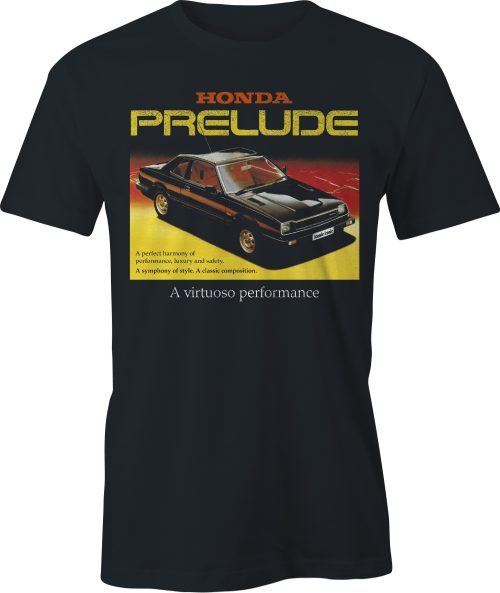
The stylish first generation Honda Prelude was launched in Japan in late 1978 and subsequently introduced in the UK and Europe during 1979.Loosely based on the 4 door Accord, the Prelude was a sleek 2 door coupe that was a very well equipped car for its time, featuring electric sunroof, electric aerial, integrated radio, remote boot release, tinted glass and a distinctive dashboard with rev counter needle sweeping inside and on the same arc as the speedometer. It was available with standard 5 speed transmission or the 'Hondamatic' auto. Also standard was typical Honda reliability, although a high price in the UK and a propensity to rust means that very few examples remain. In fact the first generation was the 'Prelude' to a stylish and distinctive coupe that evolved through five generations and 23 years, becoming ever more sophisticated with later models featuring Honda's legendary V-TEC engine and 4 wheel steering. The t shirt is based around original press advertising and features a retro distressed look to the graphics. The high contrast style of the image means that it is only available in black, but the good news is that sizes go all the way up to 5XL!
-
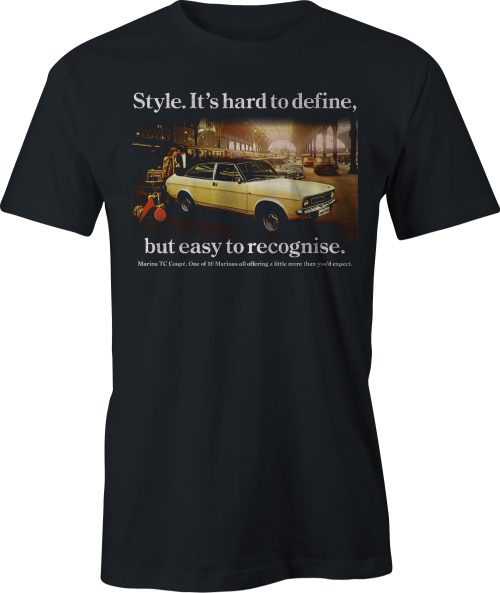
The Morris Marina, introduced in April 1971, was mechanically very simple, powered initially by the venerable 1.3 A Series and 1.8 B series engines, with a 4 speed gearbox, rear wheel drive and a live rear axle. This simplicity was at odds with other front-wheel-drive Leyland products of the time, but it meant that the Marina could compete in the conservative fleet market dominated by the likes of the Ford's Escort & Cortina, Vauxhall's Viva and Hillman's Avenger and Hunter. They were turbulent times at Leyland and money was tight so there were some compromises to be made, not least in the simple suspension set up that was based on the ancient Morris Minor and endowed the very early cars with woeful understeer, particularly in more powerful twin carb 1800 format. This was later improved, though the Marina could never be described as a sharp handler. Ironically funds also didn't stretch to stretching the doors on the 2 door coupé version. The original aim was for it to compete with the sporty Ford Capri but those saloon front doors just didn't really cut it. The Marina has since become much maligned and the butt of many lazy jokes, but the truth is that it wasn't a bad car, just a bit too staid in both styling and execution, and it's easy to forget that it was the third best selling car in the UK in the seventies. The t-shirt is based on a contemporary press ad and while it could be argued that the original wording might be pushing it a bit, the sporty 1800TC Coupé featured has definitely earned a certain retro cool now.The high contrast style of the image means that it is only available in black, but the good news is that sizes go all the way up to 5XL! Read the story of the Morris Marina here on the excellent aronline website.
-
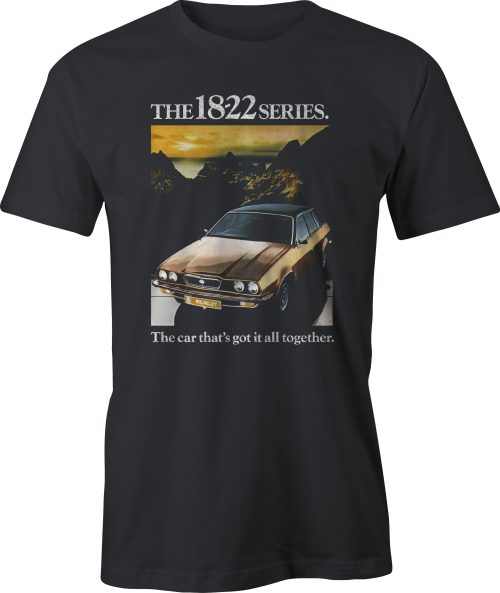
The 18-22 Series was the name given to the wedge-shaped Austin, Morris and Wolseley models launched in March 1975. Just 6 months later the badge-engineering was dropped and with minor tweaks all models became the more familiar 'Princess'. Top of the range was the Wolseley version shown here (priced at £2,838) which boasted a full length vinyl roof, velour seats with front centre armrests, push button MW/LW radio and a 2.2 litre six cylinder engine as standard, plus the famous illuminated grille badge. Just over 3,000 Wolseleys were built in those 6 months, making them incredibly rare today, and certainly the most desirable of all of the 'Princess' variants. It was also the last car to be badged as a Wolseley, a marque that had always been synonymous with luxury. The t-shirt itself is based on one of the original press ads and showcases that distinctive grille and oh-so-seventies shape and colour. The wording is as the original ad, in the authentic Goudy Old Style typeface with the super-tight kerning between each letter and features a distressed look. The high contrast style of the image means that it is only available in black, but the good news is that sizes go all the way up to 5XL!Read the story of the 18-22 / Princess here on the excellent aronline website.
-
Introduced in 1964, the Vanden Plas Princess 4 Litre R remains the only production car that is not a Rolls Royce to be fitted with a Rolls Royce engine.
It was based on a modified version of the A110 Austin Westminster bodyshell and was sent to Vanden Plas Coachbuilders in Kingsbury, London, to be finished with luxurious fittings including leather seats and real burr walnut dashboard, door cappings and picnic tables in the rear. The 3,909cc straight six Rolls Royce engine was an all-aluminium version of their B series engine with overhead inlet and side exhaust valves, hydraulic tappets and a low compression ratio of 7.8:1, making its 175 bhp output quite impressive for the time. Priced at £1,994 (around £55,000 in today’s money), the car came with Borg Warner automatic transmission and Hydrosteer power steering as standard. Only 6,555 were built between 1964 and 1968 and few survive today, due to a combination of their strong structure making them a banger racers’ favourite and their prodigious 15mpg thirst making them virtually worthless during the early 70s oil crisis. The t-shirt itself is based on one of the original press ads in which BMC certainly made the most of the Rolls Royce link. The wording is as the original ad, and features a distressed look. The high contrast style of the image means that it is only available in black, but the good news is that sizes go all the way up to 5XL!You can read more about the history of the Vanden Plas Princess 4 Litre R here. -
The Triumph Dolomite range was introduced in 1972 as a luxurious, well-equipped sporting saloon aimed at the emerging compact executive market. The Sprint version that followed in 1973 was conceived in order to remedy the gap in performance between the Dolomite 1850 and competitors such as the BMW 2002. The Sprint’s cylinder head was revolutionary for a mass produced car, featuring a multi-valve arrangement with all 16 of them operated by a single overhead camshaft. This clever design gave the car a 0-60 time of just 8.4 seconds and a maximum speed of 119 mph, very impressive for the early Seventies. The car also had alloy wheels as standard; a first for a British production car. All of this came at a launch cost of just £1,740, which compared very favourably with its other sporting rivals. The mouse mat itself is based on one of the original press ads and shows a Dolomite Sprint in the launch colour of Mimosa Yellow with black vinyl roof. The period correct typeface is used.Read more about the Triumph Dolomite and Sprint range here on the excellent aronline website.
-
The 1957 Chevrolet is certainly one of the most iconic American cars of all time, with its distinctive styling epitomising the 50s 'fins and chrome' era. In fact the Tri-Chevys (1955-1957) would also probably be considered the most popular classic car in the USA with a whole industry built around restoring and upgrading them. Part of their appeal is the legendary small-block V8 which was introduced with the 1955 model in 265 cubic inch (4,340cc) format; for 1957 this was upped to 283 ci (4,640cc) with the famous 'fuelie' 57 featuring fuel injection that gave the milestone one horsepower per cubic inch. The small-block Chevy engine has been a huge part of American culture ever since but was finally discontinued in 2003 after a remarkable 48 year life-span, with over 100 million being built! The model was available in a plethora of trim levels and body styles, from the humble One-Fifty 2 door sedan right up to the Bel Air convertible and even though they were never a huge seller in the UK, their iconic styling has featured so often in movies, music videos, toys and games that it is familiar to pretty much anyone.This t-shirt is based on a US press ad from 1957 highlights the distinctive tail fin with typical period advertising copy and illustration featuring miniature people to make the car appear even bigger! It is available in sand or white, with the latter available up to 5XL.
-
Built at Solihull, the Rover SD1 was introduced in June 1976 initially in V8 3500 guise, with the straight six versions following in November 1977. Priced at £4750.20 (including front seat belts!), it represented good value for money compared to its executive car rivals. The car was lauded for its handsome modern styling (with more than a hint of Ferrari Daytona), versatile hatchback and strong performance. The early interiors typify the seventies with their deeply sculpted (often beige) velour seats and distinctive steering wheel and dash pod. In 1982 a major mid-life facelift coincided with production being moved to Cowley, when a 2000cc model and 2400 turbo diesel was also added to the range. 1984 saw the introduction of the 190bhp fuel injected Vitesse and range-topping Vanden Plas EFi. Sadly, as was often the case with British Leyland products, the cars were dogged by bad build quality and workforce disputes that, despite numerous improvements over its life, tarnished the SD1's reputation. This is pity because from a design point of view it had very few rivals.The design of this t shirt features a very early 3500, the SD1 in its purest form and pays tribute to the original launch advertising in terms of wording and typeface with a distressed style overlaid onto it. The high contrast style of the image means that it is only available in black, but the good news is that sizes go all the way up to 5XL! Read the story of the Rover SD1 here on the excellent aronline website.
-
Introduced in 1963, the Jaguar S Type sat between the Mk2 and the MkX in terms of price, luxury and sophistication.
It was based on the Mk2, powered by Jaguar's famous XK twin-cam straight six in either 3.4 or 3.8 guise and featured the company's sophisticated independent rear suspension set up. Compared to the Mk2, the S type had a longer rear bodywork and minor changes to the front and roofline. The interior was more luxurious with extensive use of walnut and various detail improvements. The S Type can be seen in the opening credits of The Sweeney, and was driven by the police in the car chase for the film 'Robbery' (1967). Indeed, the model was a firm favourite with both coppers and criminals alike, mainly due to its excellent combination of speed and handling. The t-shirt itself is based on one of the original press ads and has the 'Grace, Space and Pace' copy line used in Jaguar's contemporary advertising that summed the cars up so perfectly. The high contrast style of the image means that it is only available in black, but the good news is that sizes go all the way up to 5XL! You can read more about the history of the Jaguar S Type here. -
The 'coke bottle' Cortina Mk3 was introduced in October 1970 replacing the more boxy Mk2 and bringing with it a swoopy new design language inspired by the products of its US parents. Engines ranged from the 1300 'Kent' cross-flow up to the 2 litre 'Pinto' overhead cam unit and five trim levels were available from base up to the twin headlight GXL. This gave the car a plethora of body, trim and price point options that helped the Cortina (in Mk3 and Mk4 guise) become the best-selling car of the 70s. The car on this mouse mat is possibly the Mk3 in its purest form, a 2 door 2000GT with the iconic four headlamp grille, Rostyle wheels and high back seats (in black vinyl, of course). The wording and type style is taken from an original press ad advertising the forthcoming 1970 Motor Show at Earls Court.